

For a long time I told myself leg strength simply was not in the cards anymore. Standing exercises are hard for me, my balance is not what it was, and the idea of a squat or a lunge makes my knees complain before I even try. My doctor said my legs were getting weaker because I was using them less, which is the quiet spiral so many of us fall into, the less you move, the harder moving feels, and the less you want to try. Then my physical therapist, a young woman named Priya, asked a question that stopped me cold. She asked why I thought I needed to stand up to strengthen my legs at all. A fair amount of leg strength, she explained, can be rebuilt while you are sitting down, if you have the right tool and a plan you can actually manage.
That tool turned out to be a set of resistance bands, the WHATAFIT set that came in the mail folded into a neat little drawstring bag with five different strengths, a couple of ankle straps, and a door anchor I honestly did not expect to use. I was skeptical at first because they look so unimpressive, just long stretchy loops. But I have been doing a seated routine three mornings a week for a few months now, and I can honestly say my legs feel steadier getting out of this chair than they have in years. My daughter noticed it before I did, she mentioned one weekend that I was not using the arms of the chair to push off anymore, and that small observation meant the world to me. This is the exact routine I use, step by step, written plain so you can start today even if you have not exercised in a very long time.
The Band Set That Gives You a Full Seated Leg Routine
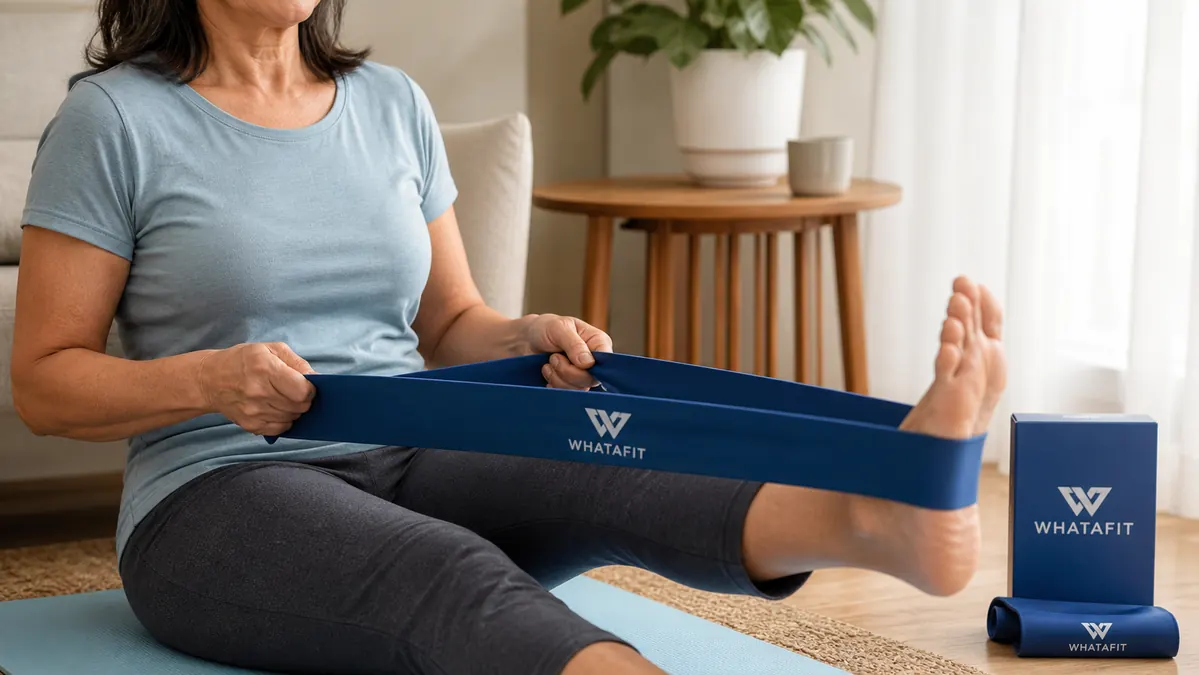
You need very little to run the routine below, and this WHATAFIT set is exactly what I use. Five bands from light to heavy, ankle straps for the lower leg work, and a carry bag so it folds away between sessions. It has been my dependable seated workout partner for months.
Amazon Check Today's Price on Amazon →Step 1: Sit tall on a firm, stable chair and set up your band
Your everyday recliner is comfortable for resting, but it is the wrong seat for this. For seated leg work you want a firm, stable chair that lets you sit tall with both feet flat on the floor. A sturdy dining chair, a straight-backed chair, or the edge of a well-supporting armchair all work. Sit close to the front edge so your back is straight, not slumped, and your thighs are roughly level with the floor. Keep both feet flat and firmly planted. This position, not the fancy equipment, is what protects your back and lets the band do its job without strain.
Set up before you start so you are not fiddling mid-movement. Loop the band around one foot and hold the ends in both hands, or sit on one side of the band and bring the other end over your knee to anchor it. The key is that the band feels snug but not stretched tight at the starting position. You want enough slack to move, with the resistance coming in as you straighten or pull. When you are starting out, choose the lightest WHATAFIT band. Five levels sounds complicated, but you will not go past the middle one for a long time, and that is exactly how it should be.
Step 2: Do knee extensions to strengthen the front of the thigh
The front of the thigh, the quadriceps, is the muscle that does the heavy lifting when you stand up from a chair and when you climb stairs. Sitting in your stable chair, loop the WHATAFIT band around one foot and hold both ends over your thigh, or press the band down under your knee to anchor it. Slowly straighten that leg out in front of you until the knee is as straight as is comfortable, hold for a second, then lower it back down. That whole motion is one rep, and it works the exact muscle you need for getting out of chairs.
Start with eight to ten slow reps on one leg, then switch to the other. Slow is the important word here. If you rush the movement, your body uses momentum instead of muscle. Going slowly, taking a full two to three seconds to straighten and another two to lower, is what actually builds strength. You should feel a working sensation in the front of the thigh, a warmth or a slight burn, but you should never feel sharp pain in the knee. If the knee complains, lower the band strength or shorten the range of motion, and it will settle down as the muscle gets stronger. I count the seconds out loud in my head the way Priya taught me, and I make sure to keep both hips square rather than letting my body twist to help. That twist is sneaky, because it takes the work out of the thigh and puts strain somewhere it should not go, usually the lower back. Once I stopped letting my body cheat, the honest effort went exactly where it belonged, and the front of my thigh finally felt the difference.
Step 3: Add ankle work for the outer thigh and the glutes
The side of the leg and the back of the hip do more than most people realize. They are the muscles that keep you steady when you turn, when you catch your foot on a rug, and when you lower yourself into a chair. To reach them, use the ankle strap included with the set. Attach one end of the band to the strap around your ankle and hold the other end, or sit on the free end so the band is taut. Sitting upright, slowly raise that foot out to the side, away from your body, keeping your knee pointing forward, until you feel the outer hip engage. Lower it back down with control.
I do this one on only my weaker side sometimes, the left, and it is remarkable how quickly the wobbliness fades. Eight to ten slow reps per side is plenty to start. If sitting all the way upright makes the movement awkward, lean just slightly toward the working leg for balance, but keep your back straight. The outer hip and glute are large muscles, so they are surprisingly responsive, and I noticed a difference in how surefooted I felt within a couple of weeks. This is the movement most people skip, and it is the one that pays off the most for everyday confidence.
Step 4: Stretch and pull for the hamstrings and calves
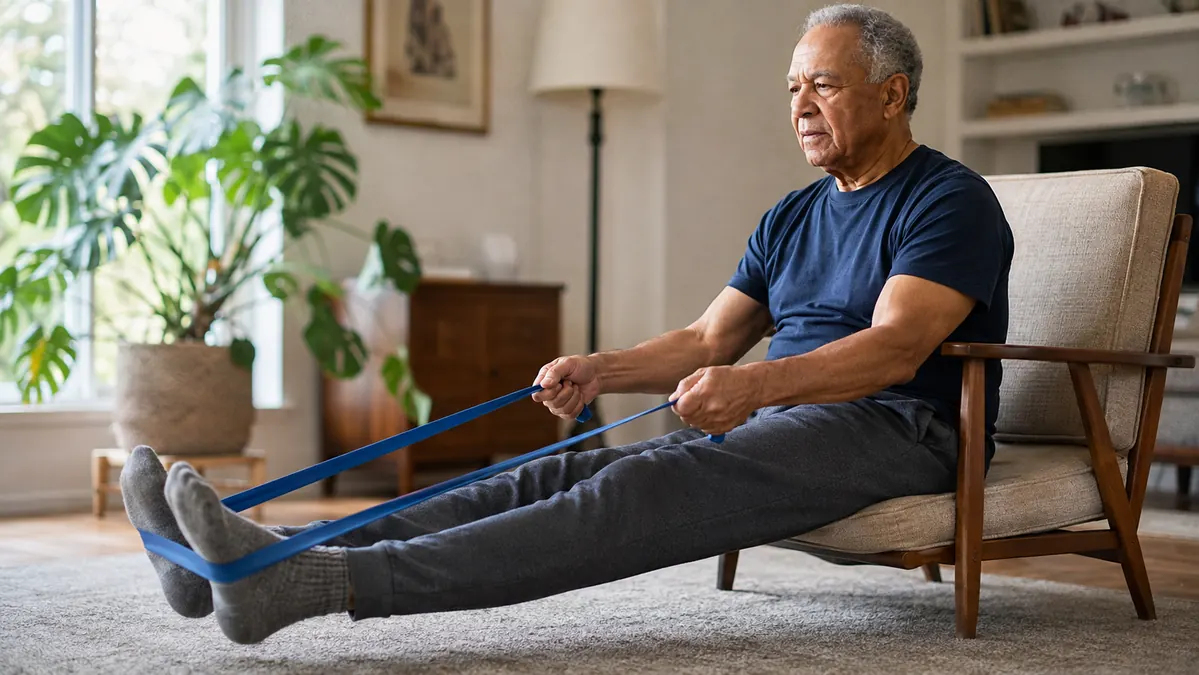
Leg strength is not only about the muscles pushing. The back of the thigh, the hamstring, and the calf in the lower leg work together when you walk and when you stop yourself from stumbling. For the hamstrings, sit with both legs out in front of you as straight as you can manage, loop the band around the ball of one foot, and hold both ends in your hands. Gently pull the band so the foot tilts toward you, feeling a stretch up the back of the leg, then release. For the calves, keep the band around the ball of the foot and gently push the toes away from you, away from the shin, feeling the calf engage. This forward lean with straight legs is the one position in the whole routine that pressed on my low back at first, so I learned to sit on a folded cushion to tip my hips forward and keep my spine long. It made the stretch go where it was supposed to instead of folding me in half.
These are smaller, gentler movements, and they are a good way to end each leg session because they wake up the full length of the leg without tiring you out. You can also use the door anchor here if you want, clipping the band near the floor and pulling toward you with your foot, but holding the band in your hands works just as well and keeps everything within reach of your chair. I keep these reps low, around six to eight per side, because they are more about keeping the tissues flexible and connected than about building bulk.
Step 5: Breathe, build slowly, and keep a consistent schedule
The whole point of this routine is not effort, it is repetition over time. Three mornings a week is better than seven days of driving yourself hard. I do the five movements above in a slow circuit, rest a minute between them, and I am done in about fifteen minutes. I breathe out on the effort, as I straighten the leg or lift the foot, and breathe in as I lower back down. Holding your breath and straining is a habit from weightlifting days that does not serve a seated routine, and you should stop and rest if you ever feel dizzy or winded.
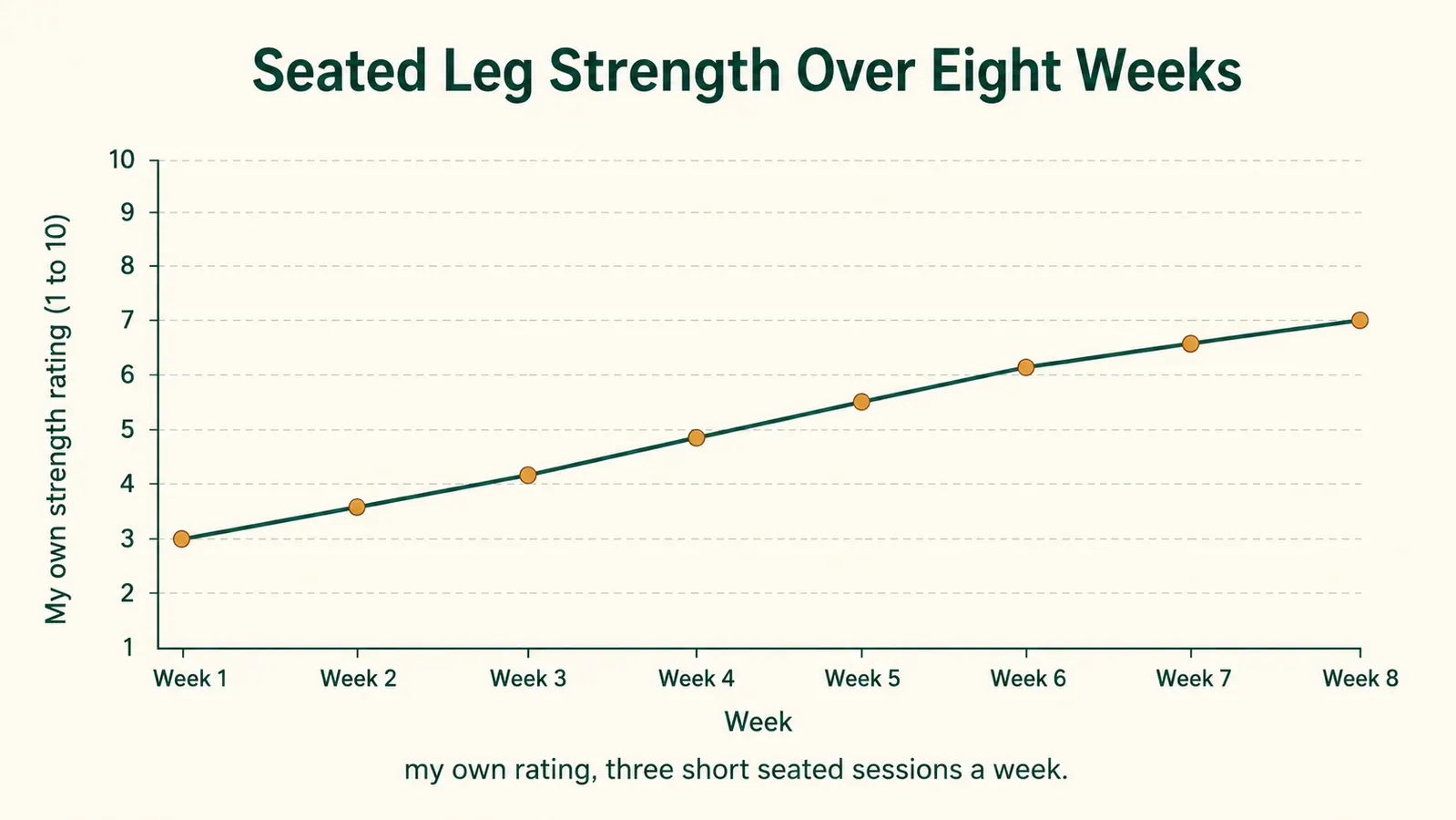
Build up gradually and let your body set the pace. Week one, I did five to eight reps per movement and used the lightest band. Week three, I added two or three reps. By the second month I had moved up one band on the knee extensions, and I still never pushed to the point of grinding pain. If a joint ever hurts sharply, stop that movement rather than pushing through it. The gentle, honest version of this routine is the one that lasts, and lasting is the entire point. Over a few months, these fifteen minutes three times a week added up to the single biggest change in how steady I feel on my feet.
What Else Helps
The bands did the heavy lifting, but a few small additions made the routine stick. I set out the chair and the band bag the night before so there is no barrier in the morning. I drink a glass of water first and do a few slow shoulder rolls before I start, so I am warmed up and not jumping cold into a stretch. And I keep a folded towel under the band where it crosses the back of my knee, because that bit of cushioning keeps the band from pinching my skin during the knee extensions. Little comforts like that make a routine you actually keep. I also keep my phone nearby with a gentle timer, because fifteen minutes passes faster than you expect once you get into a rhythm, and I found I stay more honest with myself when the movement has a clear beginning and a clear end.
I also think about what the bands are doing compared to heavier options, so I understand why they suit me. Weights demand that you hold and lift them, which is harder to do safely from a chair and harder on stiff joints. A band gives you smooth resistance through the full movement with no heavy metal to drop or fumble. If you want the full comparison and why I chose bands over dumbbells, I wrote that out here, and for my complete honest thoughts after months of seated use you can read my resistance bands set review. Whichever you read first, the seated routine above is where the real progress happens.
The whole point is not effort, it is repetition over time. Three careful mornings a week did more for my steadiness in a few months than any of my one-time attempts at hard workouts ever did.
Start Your Seated Leg Routine This Morning
Pick the lightest band, sit in your firmest chair, and do eight slow knee extensions on each leg. That is the whole first step. The WHATAFIT set gives you the five bands and the ankle straps to grow into as your legs strengthen, all in one small carry bag that tucks out of sight between sessions.
Amazon Check Today's Price on Amazon →