

I spent years assuming that getting stronger meant hefting something heavy. For most of my adult life that meant a pair of dumbbells, and for a long time a set of them lived beside my armchair where I could reach them without bending. Then my knees got cranky enough that standing lunges stopped being an option, and I had to face the question I had been putting off: could I keep my arms and legs strong without ever leaving my chair? I tried both tools to find out. The WHATAFIT resistance band set won me over, but not because it was easier to talk about. It won because it was the one I could actually do, day after day, without pain and without noise.
Here is the honest version of the trade off. Dumbbells give you a solid, familiar weight, and if you already own a light pair, they cost you nothing extra to start. But the moment your knees, hips, or balance decide you are not standing for this session, a dumbbell becomes stubborn. It wants gravity pulling straight down, which means you are working against your own joint position. Bands work differently. The resistance comes from how far the band stretches, not from how much metal you can hold, so you can get a real workout with your feet flat on the floor and your back against a chair.
Why I Brought the Dumbbells Into This
I want to be fair here, because it would be easy to write a one sided piece. I kept the dumbbells around for years and used them on good days, so I know what they can do. The reason this comparison matters is that a lot of people my age are told to just lift weights, without anyone mentioning that standing under a load is not comfortable or possible for everyone. Weights are the default in almost every conversation about strength, and I think that is a shame for people in chairs. So I ran the same moves both ways, seated, for several months, and I let the results decide rather than my loyalty to either tool.
| Feature | Resistance Bands (WHATAFIT) | Light Dumbbells |
|---|---|---|
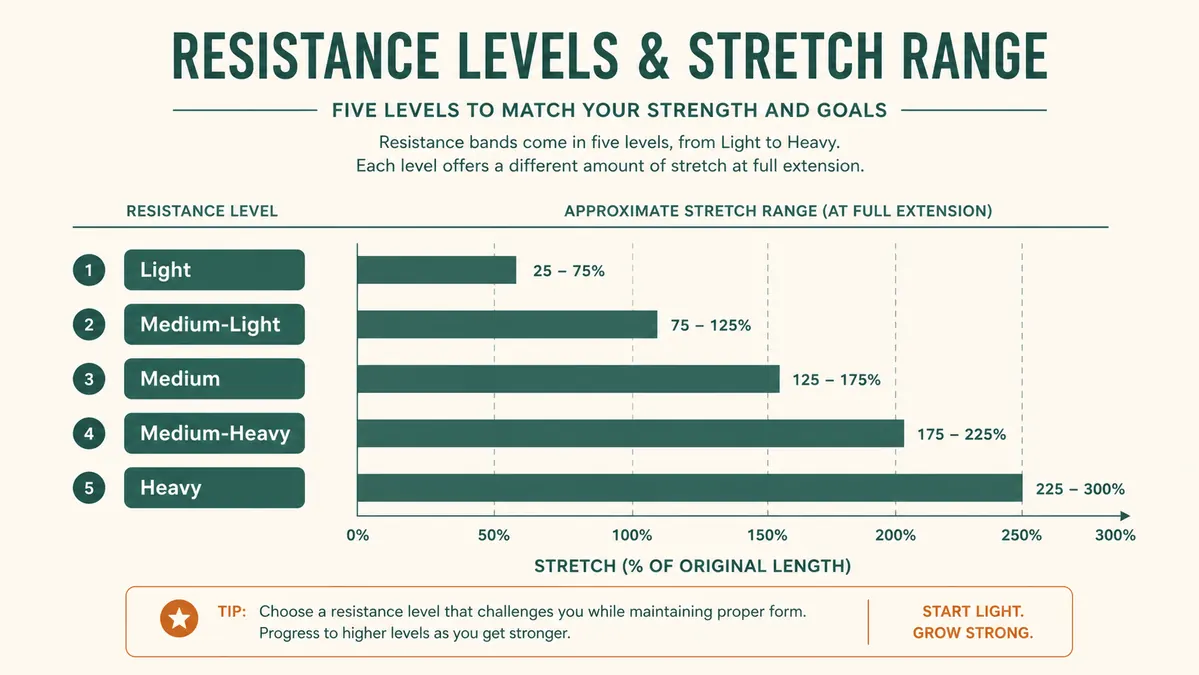
| Resistance | Five levels from light to heavy, stackable up to 150 lb by combining bands | Fixed weight per dumbbell, you buy extra pairs to go heavier |
| Joint impact | Tension builds gradually, gentler on wrists and elbows | Gravity loads the joint in one fixed line, harder to soften |
| Seated use | Works fully seated, anchored to a chair or door | Awkward seated, movement range is limited |
| Storage | Folds into a small pouch that fits in a drawer | Needs shelf or floor space |
| Set-up | Swap a band in seconds to change effort | Pick the pair up and go |
| Portability | Packs light, easy to take along | Stays at home |
| Cost to start fresh | One kit covers most home needs, check today's price | You often need several pairs to progress |
How I Tested Both for This Comparison
I did not just read the box. I spent a solid stretch living with both tools in my own living room, using each on separate days so I could tell them apart honestly. For the dumbbells I worked with a light pair I already owned, the kind most people have tucked in a closet. For the bands I used the full WHATAFIT set, all five resistance levels, the ankle straps, and the door anchor. I kept the same goals in mind for both, mostly a stronger back, steadier legs, and shoulders that do not ache by evening, and I wrote down how each one felt to use from a chair.
Two things I watched closely were how much I dreaded each tool and how easy it was to start on a low-energy day. Consistency matters more than any single session, especially at my age, so the tool I was willing to reach for won on attitude long before it won on any other measure. I also kept track of joint discomfort the next morning, because an exercise that leaves me stiff does me no favors even if it feels strong in the moment.
Where Resistance Bands Win
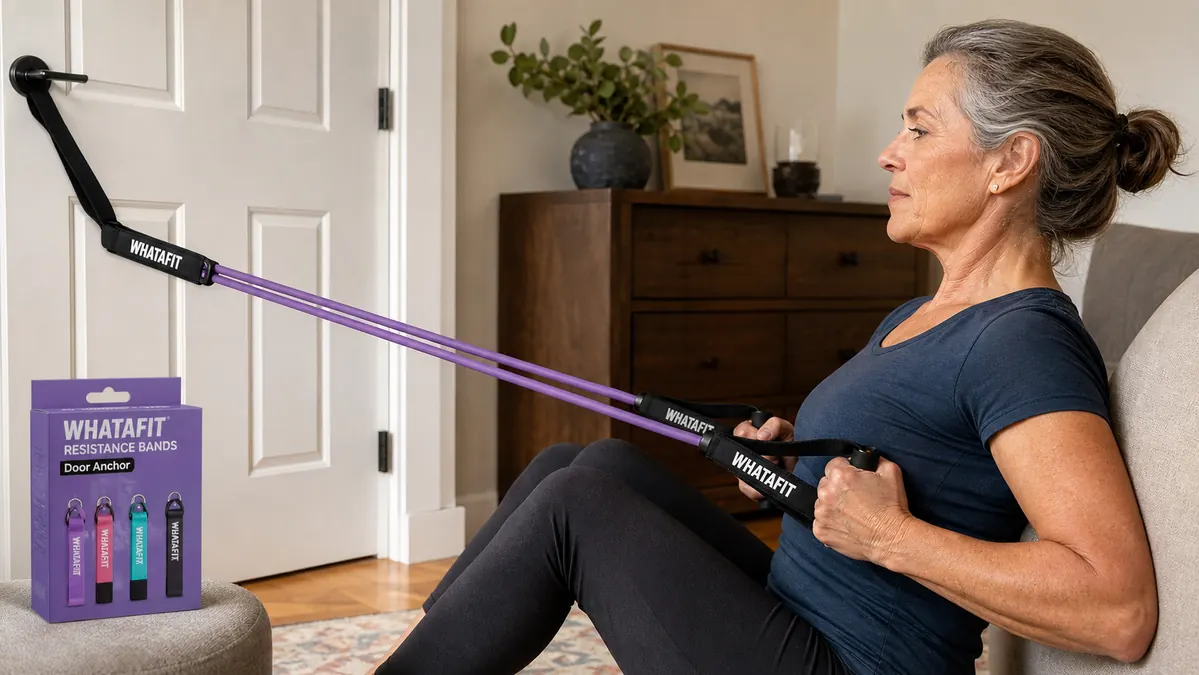
The biggest difference shows up in the first minute. With the WHATAFIT set, everything stays within arm's reach, which matters when your mobility already limits how much you can bend and twist. I sit in my padded kitchen chair, hook the door anchor over the top edge, and I am ready. The bands come in five resistance levels, and each one is a different color and a different thickness, so picking the effort I want takes about a second. Because the tension builds as the band stretches, my joints tell me when to stop well before I hit an abrupt wall. That gradual feel is exactly what a stiff wrist or a finicky elbow needs.
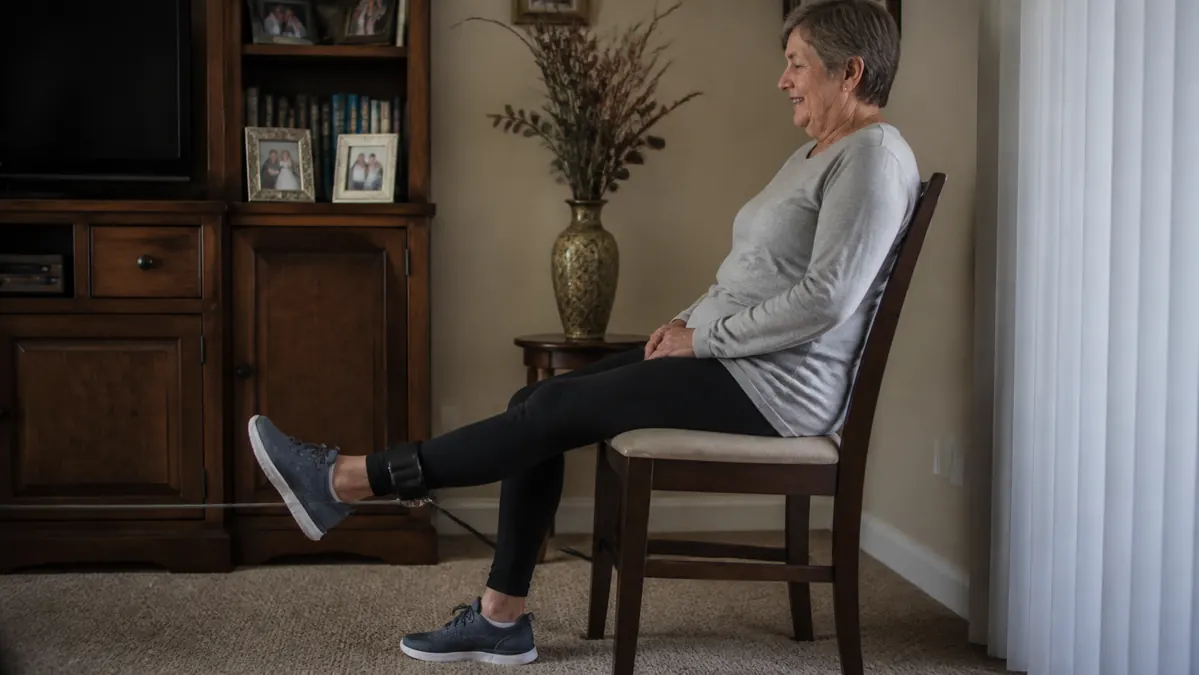
There is also the question of noise and trust. A dropped dumbbell landing on a hardwood floor makes a sound that can rattle the whole room, and reaching down to pick it up off my toes is exactly the sort of motion my back no longer likes. The bands cannot really fall on anything. The loop bands wrap around my ankles without me having to bend, and the handles stay in my grip. Even on the rare day my hands feel weak, I can loop a band around my wrist instead of trying to grip a cold metal bar. That small flexibility, honestly, is why I keep reaching for them.
Where Light Dumbbells Win
I am not going to pretend the bands are better at everything, because they are not. Dumbbells have a clear strength when you want to progress in a very controlled, predictable way. A weight does not stretch, so what you feel at the start of a movement is nearly what you feel at the end. For certain motions, like a straight overhead press or a classic bicep curl with your forearm vertical, a dumbbell gives a steadier, more familiar line of resistance. If you have used weights before, the movement pattern feels second nature from the first rep.
The other honest advantage is effort without fuss. With a dumbbell there is no anchor to set up and no band to swap if you want a change. You just pick the pair you want and lift. That is a real convenience for someone who has a dedicated spot and a light pair already bought. Calibrated progress is easier to track too, because the number on the side tells you exactly how much you did last week. If you miss the simple, familiar feel of metal in your hands, no band set fully replaces it, and I would not pretend otherwise.
What the Bands Won't Do for You
I would be lying if I said the bands replace every benefit of weight. A heavy dumbbell trains raw, maximal effort in a way a stretchy band never quite matches, because at the very top of a lift a band is at its tightest and that is where your arms are closest to their strongest. Some people also find the feel of a hard weight more satisfying, because it is a number they can point to. If your main goal is chasing a specific poundage, dumbbells are the more direct tool. For my goal, which is staying usable and strong enough for everyday life, the bands give all the challenge I need.
If a chair is where you train, start with the bands
The WHATAFIT set gives you five resistance levels, ankle straps, a door anchor, and a printed guide, all in one kit that fits in a drawer. It is the gentle option that still gets serious work done.
Amazon Check Today's Price on Amazon →What a Seated Workout Actually Looks Like
The routine I settled into takes about twenty minutes, three or four times a week, and I do all of it sitting down. I start with the lightest band and a seated row, looping the band around the door anchor and pulling toward my stomach with my shoulders relaxed. Then I switch to ankle straps for seated leg extensions, straightening each leg out in front of me. The tension surprises people the first time. It is not a token effort. By the last rep my thigh is genuinely working, which is what I want without any standing involved.
I add a set of seated shoulder presses with the mid band, and I finish with gentle chest pulls. The whole thing keeps my pulse up a little, keeps my joints moving through their normal range, and leaves me feeling looser rather than locked up. I keep a small timer on the table and a notebook listing which band color I used, so I can feel myself edging stronger without having to measure anything. My physical therapist, who knows I train from a chair, said the seated rows and leg extensions are the two she would have picked for me, which told me I was on the right track.
I should also mention that I started very gently. The first week I used only the lightest band and did maybe ten repetitions of each move, which felt almost too easy, and that is exactly what I wanted. Building a habit beats proving a point. Over the following weeks I added repetitions, then moved up a band color on the moves that felt comfortable. Nobody was timing me or watching me struggle, and that is the whole appeal of doing this at home from a chair. It is private, it is quiet, and I can stop the moment I need to without anyone's permission.
Six weeks in, the band I started with felt easy, so I moved up a level and my arms knew the difference. That is proof to me that a chair workout can build real strength.

Who Should Buy Which
Here is the honest line I have landed on. If most of your workouts are going to happen in a chair, if your knees or hips make standing uncomfortable, if you live in a small home, or if you travel and want to stay consistent, the resistance band set is the better fit for you, and the WHATAFIT one covers the ground well. If you already own a light pair of dumbbells, have a clear space to use them, and miss the familiar feel of a fixed weight in your hands, then keeping them is a reasonable choice. But if you are starting fresh and wondering which to buy, I would pick the bands, because they fit the actual way you live and train.
One more piece of plain advice. Start lighter than you think you need, do each movement through a full comfortable range, and stop before a joint complains. The bands let you do exactly that, which is why they have earned the spot beside my chair where the dumbbells used to sit.
My Bottom Line
If you are healthy enough to stand and comfortably handle a fixed weight in a clear space, a light dumbbell is still a fine tool, and I would never tell you otherwise. But for someone in my situation, someone who trains in a chair, keeps a small home, and prefers to avoid loading stiff joints, the resistance band set fits the life I actually live. The WHATAFIT set is the one beside my chair now. It covers every seated move I need, it stores away in seconds, and six months in it still holds its stretch and its color. That is why it won this comparison, not because of anything flashy, but because it made strength work something I could do every week without getting hurt.
Train where you are, not where you used to be
The WHATAFIT set is the kit I reach for every week from my chair: five levels, ankle straps, a door anchor, and a simple guide. If you have been putting off strength work because standing is hard, this is a gentle place to start.
Amazon Check Today's Price on Amazon →